
Poker tournaments in Australia range from small weekly competitions at local clubs to major multi-week festivals attracting professional and recreational players from across the country.
The Australian poker tournament calendar includes events in Sydney, Melbourne, Brisbane, the Gold Coast, Adelaide and other cities. Players can choose between affordable freezeouts, satellites, bounty tournaments, deep-stack events and championship competitions with buy-ins worth several thousand Australian dollars.
This guide covers the main poker tournaments Australia has to offer, including upcoming live events, leading poker tours, tournament formats, schedules and results.
The Australian tournament scene is built around several major poker series:
The exact poker tournament schedule can change during the year. Players should always confirm the dates, entry conditions and registration deadlines with the organiser or host venue before travelling.
| Poker event | Dates | Location | Main highlights |
|---|---|---|---|
| Aussie Millions | 24 April–10 May 2026 | Crown Melbourne | 18 tournaments, AU$10,600 Main Event |
| APLPT Sydney | 14–19 July 2026 | Canterbury-Hurlstone Park RSL | More than AU$450,000 in event guarantees |
| APL Million | 14–31 August 2026 | Southport Sharks, Gold Coast | 100 events and over AU$7.5 million in guarantees |
| WPT Australia | 10–30 September 2026 | The Star Sydney | 36 events, Prime and Main Tour championships |
| APLPT Brisbane | 6–11 October 2026 | Brisbane | Regional APL Poker Tour series |
Dates and schedules may be updated by tournament organisers.
Australia has hosted some of the most recognised poker championships in the Asia-Pacific region. The largest events combine substantial prize pools, professional tournament structures and multiple starting flights.

Aussie Millions is one of the biggest poker tournaments in Australia and historically one of the country’s most internationally recognised poker series.
The 2026 championship took place at Crown Melbourne from 24 April to 10 May. It featured 18 days of poker and 18 separate tournaments. Buy-ins ranged from approximately AU$1,500 to AU$25,000, with the Main Event priced at AU$10,600.
The completed series generated more than AU$22.5 million in total prize money. Australian player Malcolm Trayner won the 2026 Main Event and received AU$1,667,050.
Typical Aussie Millions events include:
Because the festival attracts large fields and experienced international players, it is generally best suited to players who already understand live tournament procedures.
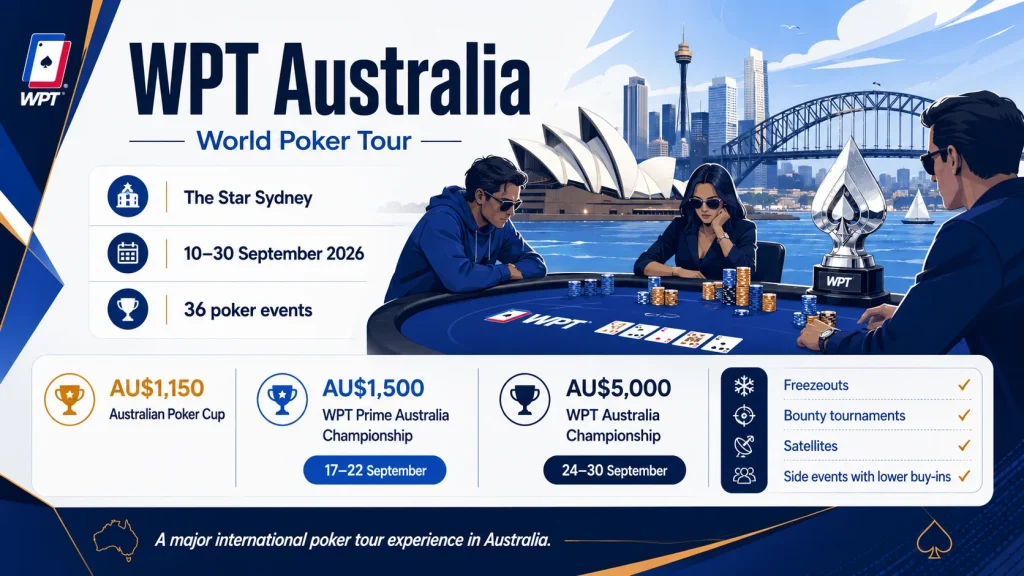
The World Poker Tour returns to The Star Sydney from 10 to 30 September 2026.
The festival is scheduled to include 36 poker events, making it one of the largest live poker series on the Australian poker tournament calendar. Major competitions include:
The WPT Prime Australia Championship is scheduled for 17–22 September, while the AU$5,000 WPT Australia Championship is scheduled for 24–30 September.
WPT Australia is likely to appeal to players who want a major international poker tour experience without travelling outside Australia.

The APL Million is a large Australian Poker League festival held at Southport Sharks on the Gold Coast.
The 2026 series is scheduled for 14–31 August and is expected to feature:
Feature events may include the Centurion, Jackstar Super High Roller, Mystery Bounty, Deep Freeze, Monster Stack and One-Shot Freezeout.
The broad buy-in range makes the APL Million accessible to both casual players and experienced tournament regulars.
The Australian Poker Tour, commonly known as APT, organises poker events in different Australian cities throughout the year.
Its 2026 season includes stops such as:
APT tournaments commonly offer multiple starting flights, affordable preliminary events, bounty formats, teams events, Monster Stacks and a Main Event.
The tour is particularly popular with recreational players looking for a structured multi-event poker festival without the higher entry prices associated with major international championships.
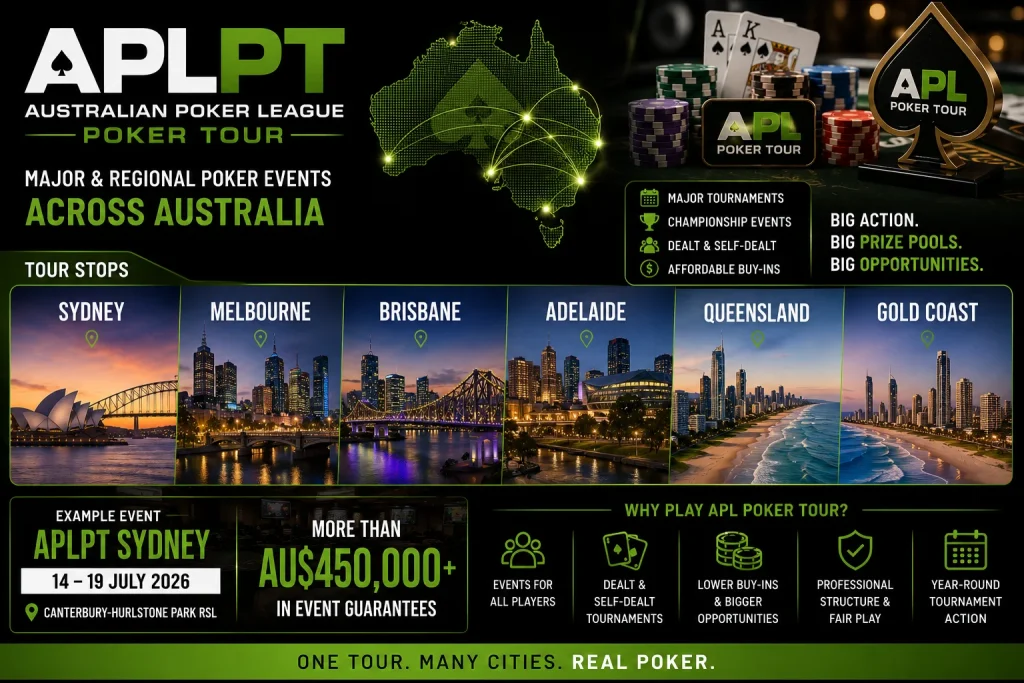
The Australian Poker League Poker Tour, or APLPT, runs major and regional poker events across Australia.
Its schedule may include stops in:
For example, APLPT Sydney ran from 14 to 19 July 2026 at Canterbury-Hurlstone Park RSL, featuring more than AU$450,000 in event guarantees.
APL events often include both dealt and self-dealt tournaments, allowing organisers to provide lower-cost entry options alongside larger championship competitions.
Live poker tournaments are played at a physical venue with real cards, chips, dealers and tournament staff.
Depending on the event, registration may be available:
Players should bring valid photo identification and confirm the venue’s minimum age requirements. Casino poker rooms generally require players to be at least 18 years old.
A freezeout gives each player one tournament entry. Once all chips are lost, the player is eliminated.
Freezeouts suit players who prefer a straightforward structure without unlimited re-entry costs.
A re-entry tournament allows eliminated players to purchase another entry during the designated registration period.
Before entering, check:
In a Mystery Bounty poker competition, part of the prize pool is reserved for knockout prizes. Players who eliminate an opponent after the bounty phase begins draw a prize of an unknown value.
Some bounties can be significantly larger than the minimum payout.
In a progressive knockout tournament, a player receives part of an opponent’s bounty after eliminating them. The remaining portion is added to the winner’s own bounty.
Monster Stack events provide players with a larger starting stack than a standard tournament.
These competitions usually offer more post-flop play and reduce the pressure to take major risks during the first few levels.
Turbo tournaments use shorter blind levels. Hyper-turbo competitions are even faster.
These formats usually:
Satellites award entry into a more expensive poker tournament instead of paying the entire prize pool in cash.
For example, a player may enter an affordable satellite to try to win a seat in an AU$1,500 or AU$5,000 championship.
At the beginning of a poker tournament, each player receives the same number of tournament chips.
These chips do not have a direct cash value and cannot normally be exchanged for money during the event. Players continue until they lose all their chips or reach an agreed finishing position.
Blinds increase at scheduled intervals. As the tournament progresses:
The tournament ends when one player controls all chips in play.
The buy-in is the amount paid to enter a poker tournament.
A listed entry such as AU$450 + AU$50 usually means:
Tournament listings may also show:
Players should calculate their full potential cost before registering, especially when multiple re-entries or add-ons are available.
Not every Australian poker event is part of a major national tour.
Local leagues, clubs and licensed venues may run:
Entry prices can be considerably lower than those charged by major casino festivals. However, tournament structures, dealer arrangements and prize formats vary between organisers.
Players should check whether a local poker competition is:
Access to real-money online poker tournaments is legally restricted in Australia.
Under the Interactive Gambling Act 2001, online operators are prohibited from providing conventional real-money online poker services to people located in Australia. Some offshore poker websites may still be technically accessible, but accessibility does not mean that the operator is authorised to serve Australian players.
Offshore platforms may involve:
Australian players should verify the current legal position and platform availability before opening an account or making a payment.
Free-play platforms and subscription-based poker apps may offer tournaments using virtual chips or qualification systems. However, virtual chips usually cannot be withdrawn as cash.
The best way to build an accurate poker tournament calendar is to use official sources.
Check:
Before attending an event, confirm:
Major poker series can update their schedule, cancel individual side events or change starting times.
The biggest poker tournament is not automatically the best choice for every player.
Choose an event with an entry price you can afford to lose.
Do not assume that a large guaranteed prize pool makes a tournament profitable for an individual player. Tournament poker has substantial variance, and even skilled players can experience long periods without a major result.
A slower structure generally gives players more time to make decisions.
Look for:
Fast tournaments may be more convenient but provide less opportunity to recover from an early mistake.
A low advertised buy-in can become expensive when several re-entries are permitted.
Decide on a maximum number of entries before playing.
Major poker championships can attract professionals and experienced tournament players. Smaller local events may provide a more relaxed environment for beginners.
Multi-day events may require players to return for Day 2 or the final table.
Allow for:
Poker tournament results help players follow major Australian events, compare performances and review how prize pools were distributed. Results are usually published after an event has finished, although live updates may also be available during larger poker series.
A standard results page normally shows:
For multi-day events, organisers may also publish chip counts, Day 1 qualifiers, final-table line-ups and updates from key hands. Major poker tournaments often provide more detailed coverage, including player interviews, photographs and reports from the final stages of the event.
Results from recognised poker tours may be published by the tournament organiser, the host casino, specialist poker media or an established poker results database. Players should use official or reputable sources because unofficial listings may contain incomplete payouts, incorrect player names or outdated information.
Prize figures should also be checked carefully. Australian tournament results are usually displayed in Australian dollars, but international poker databases may show amounts in US dollars or another currency. Some listings may report the full prize pool, while others show only the amount won by each final-table player.
It is also important to distinguish between the advertised guarantee and the final prize pool. A tournament may promote a guaranteed amount before registration closes, but the actual prize pool can be higher if more players enter or purchase re-entries.
The 2026 Aussie Millions Main Event, for example, was won by Malcolm Trayner, who received AU$1,667,050. Major results such as this are typically published together with the number of entries, final-table payouts and overall event statistics.
Players looking for recent poker tournament results in Australia should check the official website of the poker series or venue and confirm the event date, currency and tournament format before comparing winnings.
Arrive before the scheduled start so that you have time to register and locate your table.
During the tournament:
Players unfamiliar with live poker should begin with a lower-buy-in event before entering a major championship.
Poker tournaments involve financial risk. A player may make correct decisions and still be eliminated without receiving a prize.
Set a fixed budget covering:
Never use money required for rent, bills, debt repayments or essential household costs.
Tournament poker should be treated as paid entertainment rather than a reliable source of income.
Find answers about major Australian poker tournaments, upcoming events, buy-ins, schedules, live competitions and online poker rules.
The most recognisable major events include Aussie Millions, WPT Australia, the APL Million, Australian Poker Tour championships and APL Poker Tour series.
Large poker events are commonly held in Melbourne, Sydney, Brisbane, Adelaide and on the Gold Coast. Crown Melbourne, The Star Sydney, Southport Sharks and major club venues regularly host poker festivals.
WPT Australia is scheduled to run at The Star Sydney from 10 to 30 September 2026. The festival includes the AU$1,500 WPT Prime Australia Championship and the AU$5,000 WPT Australia Championship.
The APL Million is scheduled for 14–31 August 2026 at Southport Sharks on the Gold Coast. It is expected to include around 100 events and more than AU$7.5 million in guarantees.
Small local events may cost less than AU$100, while major championships can cost AU$1,000, AU$5,000 or more. The 2026 Aussie Millions Main Event had an AU$10,600 buy-in.
Yes. Many Australian poker events are open to recreational players. Beginners should look for lower-buy-in freezeouts, beginner-friendly club events and tournaments with slower blind structures.
For most recreational players, gambling winnings are generally not treated in the same way as ordinary employment income. However, the position may differ where poker activities are conducted as a business. Players with substantial or regular winnings should obtain personal tax advice.
Operators are prohibited from offering conventional real-money online poker services to people in Australia under the Interactive Gambling Act 2001. Offshore availability does not mean a platform is authorised in Australia.
Check official pages operated by the tournament series, casino, poker room or host venue. Confirm all details directly before booking travel because schedules can change.
A poker series is a group of tournaments held at the same venue over several days or weeks. It may include satellites, bounty events, side tournaments, high rollers and a Main Event.
A poker circuit or poker tour runs separate tournament series in multiple cities or venues during a season. Players may also earn rankings, leaderboard points or qualification into a season final.